
Comparing Air Quality Targets Around the World - Part 3: TVOC and Formaldehyde
Air quality targets around the world are used to define what "clean air" means, but a building that passes one standard can be ten times less stringent than another standard.
This comparison looks at air quality targets from 16 government standards and building certifications from North America, Europe, and Asia-Pacific to show where they agree and where they diverge.
About This Series
This article is Part 3 of 4 in the Air Quality Target Comparison Series. We are splitting the full master comparison into four focused articles for readability:
Part 1 — Particulate Matter: PM2.5 & PM10
Part 2 — Carbon Gases: CO2 + CO
Part 3 — Organic Chemicals: TVOC + Formaldehyde
Part 4 — Inorganic Gases & Radon: Ozone, Nitrogen Dioxide, Sulfur Dioxide, and Radon
Standards referenced in this series (16 total): WHO 2021, EPA NAAQS, EU Directive 2024/2881, Singapore SS 554 (2021), China GB/T 18883, RESET Air v2.0, LEED v5 O+M, WELL v2, Fitwel, Living Building Challenge (LBC), ASHRAE 62.1 (2022), DGNB, BOMA BEST, Singapore Green Mark, HKGBC BEAM Plus, and China Green Building Standard.
How to read this comparison
Averaging periods matter. Different standards use different averaging periods, and concentration limits should therefore be interpreted together with their corresponding exposure durations. In this report, Daily, Short-term, and Unspecified limits are grouped together to improve readability and allow for a clearer comparison of how targets change across different averaging periods, from short-term to daily exposure.
Short: Short-term peak exposure (15m, 30m, 1h)
Daily: Workday or daily exposure (4h, 8h, 24h)
Annual: Long-term chronic exposure
Unspecified: The standard does not define an averaging period for the reported limit
Type: Each standard is marked as Government (national codes, regulations, guidelines) or Certification (voluntary building certification or private framework).
TVOC and Formaldehyde
What they are: Volatile Organic Compounds (VOCs) are carbon-based chemicals that easily evaporate into the air at room temperature. Total Volatile Organic Compounds (TVOC) measures the collective concentration of these chemicals floating around you. Formaldehyde (HCHO) is a specific, simple organic gas, and one of the most common, potent VOCs found indoors.
Where they come from: While some VOCs come from nature, indoor sources are everywhere. TVOCs come from everyday products like paints, cleaning solvents, air fresheners, personal care items, and cooking fumes. Formaldehyde is widely used as an industrial adhesive and binder, meaning it continuously off-gasses from pressed-wood products (particleboard, plywood), new furniture, carpeting, foam insulation, and synthetic fabrics.
Why they're dangerous: Short-term exposure to high TVOC or formaldehyde levels causes immediate irritation: stinging eyes, throat burning, headaches, dizziness, and triggered asthma attacks. Long-term chronic exposure is far more concerning. Formaldehyde is a classified Group 1 human carcinogen, strongly linked to nasopharyngeal cancer and leukemia. Continuous high VOC exposure can also lead to central nervous system damage, liver and kidney toxicity, and chronic respiratory illness.
The indoor pollution paradox: Unlike outdoor smog, VOCs are overwhelmingly an indoor problem. Concentration levels are typically 2 to 5 times higher indoors than outdoors, and in newly renovated or freshly painted buildings, concentrations can spike to 100 times higher, creating what is commonly known as "Sick Building Syndrome."
Source control is the primary fix: You cannot simply filter VOCs out with standard dust filters. Because they are gases rather than particles, standard HEPA filters do nothing to remove them. Clearing VOCs requires activated carbon filtration or dilution ventilation. More importantly, real protection relies on source control: choosing zero-VOC paints, specifying formaldehyde-free composite wood, and allowing new furnishings to fully off-gas outdoors before bringing them inside.
TVOC
Summary
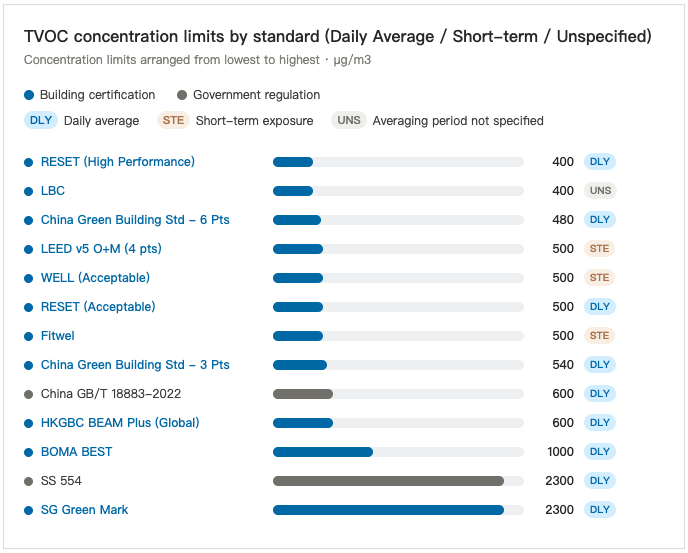
Range: 400 to 2300 µg/m³, a 5.75-fold gap, across 13 limits.
Strictest: RESET (High Performance) and LBC at 400 µg/m³, followed by China Green Building Std (6 Pts) at 480 µg/m³.
Most common value: 500 µg/m³, where four certifications converge: LEED v5 O+M (4 pts), WELL (Acceptable), RESET (Acceptable), and Fitwel.
Mid-range progression: Steps from China Green Building Std (3 Pts) at 540 µg/m³ to China GB/T 18883-2022 and HKGBC BEAM Plus at 600 µg/m³, then BOMA BEST at 1000 µg/m³.
Upper end: SS 554 and SG Green Mark at 2300 µg/m³ (converted from 1000ppb).
Type split: Voluntary certifications cluster heavily at the strict end (400–500 µg/m³), while national standards define higher acceptable limits (600–2300 µg/m³).
| Standard | Limit | Averaging | Type |
|---|---|---|---|
| RESET (High Performance) | 400 µg/m³ | Daily | Certification |
| LBC | 400 µg/m³ | Unspecified | Certification |
| China Green Building Std (6 Pts) | 480 µg/m³ | Daily (8h) | Certification |
| LEED v5 O+M (4 pts) | 500 µg/m³ | Short-term | Certification |
| WELL (Acceptable) | 500 µg/m³ | Short-term | Certification |
| RESET (Acceptable) | 500 µg/m³ | Daily | Certification |
| Fitwel | 500 µg/m³ | Short-term | Certification |
| China Green Building Std (3 Pts) | 540 µg/m³ | Daily (8h) | Certification |
| China GB/T 18883-2022 | 600 µg/m³ | Daily (8h) | Government |
| HKGBC BEAM Plus (Global) | 600 µg/m³ | Daily (8h) | Certification |
| BOMA BEST | 1000 µg/m³ | Daily | Certification |
| SS 554 | 2300 µg/m³ (1000 ppb) | Daily (8h) | Government |
| SG Green Mark | 2300 µg/m³ (1000 ppb) | Daily (8h) | Certification |
Formaldehyde
Summary
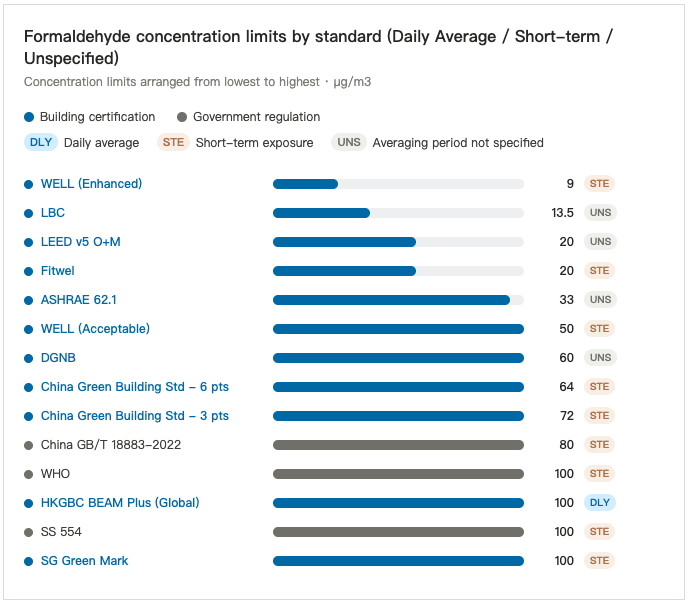
Range: 9 to 100 µg/m³, an 11.1-fold gap, across 14 limits.
Strictest: WELL (Enhanced) at 9 µg/m³, followed by LBC at 13.5 µg/m³, and LEED v5 O+M and Fitwel at 20 µg/m³.
Most common value: 100 µg/m³, where four major benchmarks converge: WHO Guidelines, HKGBC BEAM Plus, SS 554, and SG Green Mark.
Mid-range progression: Steps through ASHRAE 62.1 at 33 µg/m³, WELL (Acceptable) at 50 µg/m³, DGNB at 60 µg/m³, China Green Building Std (6 pts) at 64 µg/m³, China Green Building Std (3 pts) at 72 µg/m³, and China GB/T 18883-2022 at 80 µg/m³.
Upper end: WHO Guidelines, HKGBC BEAM Plus, SS 554, and SG Green Mark at 100 µg/m³.
Type split: Certifications dominate the low to mid end (9–72 µg/m³), whereas government and global health baselines anchor the upper boundary (80–100 µg/m³).
| Standard | Limit | Averaging | Type |
|---|---|---|---|
| WELL (Enhanced) | 9 µg/m³ | Short-term | Certification |
| LBC | 13.5 µg/m³ | Unspecified | Certification |
| LEED v5 O+M | 20 µg/m³ | Unspecified | Certification |
| Fitwel | 20 µg/m³ | Short-term | Certification |
| ASHRAE 62.1 | 33 µg/m³ | Unspecified | Certification |
| WELL (Acceptable) | 50 µg/m³ | Short-term | Certification |
| DGNB | 60 µg/m³ | Unspecified | Certification |
| China Green Building Std (6 pts) | 64 µg/m³ | Short-term (1h) | Certification |
| China Green Building Std (3 pts) | 72 µg/m³ | Short-term (1h) | Certification |
| China GB/T 18883-2022 | 80 µg/m³ | Short-term (1h) | Government |
| WHO | 100 µg/m³ | Short-term (30min) | Government |
| HKGBC BEAM Plus (Global) | 100 µg/m³ | Daily (8h) | Certification |
| SS 554 | 100 µg/m³ | Short-term (30min) | Government |
| SG Green Mark | 100 µg/m³ | Short-term (30min) | Certification |
Conclusion: What the TVOC and Formaldehyde Targets Tell Us
Comparing indoor volatile organic compound targets across international standards highlights two distinct challenges: managing an aggregate mixture of unknown chemical composition (TVOC) versus mitigating a known, high-potency carcinogen (Formaldehyde).
TVOC: A broad operational metric with regional divergence
Total Volatile Organic Compounds act as a screening tool for overall chemical off-gassing from furniture, paints, cleaners, and building materials. The comparison reveals two clear clusters:
The Global Performance Consensus (400–500 µg/m³): Leading building frameworks including RESET, WELL, LEED v5, Fitwel, and Living Building Challenge have converged tightly around 400 to 500 µg/m³. This agreement establishes 500 µg/m³ as the universal benchmark for acceptable indoor chemical load, with 400 µg/m³ representing optimized performance.
Regional Baseline Outliers (1,000–2,300 µg/m³): Singapore's SS 554 and SG Green Mark at 2,300 µg/m³ (converted from 1000ppb) seem to reflect older legacy thresholds or higher outdoor baseline allowances, leaving a more than 5-fold spread between regional codes and high-performance building certifications.
Formaldehyde: Driven by cancer risk and sensory irritation
Unlike TVOC, formaldehyde (HCHO) is a specific compound classified as a Group 1 human carcinogen. Because its health impacts range from acute sensory irritation to long-term chronic risks, thresholds vary significantly based on regulatory priorities:
Upper Safety Baselines (80–100 µg/m³): Health-focused baselines set by the World Health Organization (100 µg/m³ for 30-minute exposure), Singapore (SS 554), and China's updated national standard GB/T 18883-2022 (80 µg/m³) focus primarily on preventing acute sensory irritation and short-term respiratory discomfort.
Aggressive Chronic-Risk Targets (9–20 µg/m³): Progressive frameworks like WELL Enhanced (9 µg/m³), LBC (13.5 µg/m³), LEED v5, and Fitwel (20 µg/m³) set targets up to 11 times stricter than the WHO guideline. These thresholds account for chronic long-term exposure and emphasize stringent material selection over reliance on dilution ventilation.
The broader takeaway
While government codes and health guidelines (WHO, SS 554, GB/T) establish 100 µg/m³ formaldehyde and 600–2,300 µg/m³ TVOC as upper bounds for basic safety, commercial building certifications typically adopt more stringent indoor air quality targets to support healthier indoor environments.
For building owners and operators, meeting modern indoor air quality expectations therefore means capping TVOC below 500 µg/m³ and driving formaldehyde down to 20 µg/m³ or lower through proactive material specification and source control.
Regulatory limits define the point at which air quality becomes unacceptable. High-performance buildings aim for air quality that actively supports occupant health, comfort, and productivity.
In Part 4, we apply this same lens to Ozone, Nitrogen Dioxide, Sulfur Dioxide, and Radon.
Appendix: Standards List and Resources for Organic Chemicals
Government standards, codes, and guidelines (3 total):
World Health Organization (WHO). WHO Guidelines for Indoor Air Quality: SELECTED POLLUTANTS. p. 20.
Singapore SS 554 (2021) : SS 554:2016+A1:2021 Code of Practice for Indoor Air Quality for Air-Conditioned Buildings. p. 20.
China GB/T 18883-2022: GB/T 18883-2022 室内空气质量标准. p. 3.
Building certifications and private frameworks (11 total):
RESET Air v2.0: RESET Air Standard.
LEED v5 O+M: LEED v5 Reference Guide for Building Operations and Maintenance. November 2025 Edition, pp. 67–68.
WELL v2: The WELL Building Standard v2.
Fitwel: Fitwel v3 Indoor Air Quality Assessment Protocol. p. 13.
Living Building Challenge (LBC): Living Building Challenge 4.1 Program Manual. January
ASHRAE 62.1 (2022): ANSI/ASHRAE Standard 62.1-2022: Ventilation for Acceptable Indoor Air Quality. 2022, p. 2.
DGNB: DGNB System – Buildings In Use, Criteria Set Version 2026. 2026, pp. 148.
BOMA BEST: BOMA BEST Field Guide.
Singapore Green Mark: SS 554:2016+A1:2021 Code of Practice for Indoor Air Quality for Air-Conditioned Buildings. p. 20.
HK BEAM PLUS: Existing Buildings Global Version. p. 157.
China Green Building Standard: 《绿色建筑评价标准》. 2024, p. 6.
