
Comparing Air Quality Targets Around the World - Part 2: CO2 and CO
Air quality targets around the world are used to define what "clean air" means, but a building that passes one standard can be ten times less stringent than another standard.
This comparison looks at air quality targets from 16 government standards and building certifications from North America, Europe, and Asia-Pacific to show where they agree and where they diverge.
About This Series
This article is Part 2 of 4 in the Air Quality Target Comparison Series. We are splitting the full master comparison into four focused articles for readability:
Part 1 — Particulate Matter: PM2.5 & PM10
Part 2 — Carbon Gases: CO2 + CO
Part 3 — Organic Chemicals: TVOC + Formaldehyde
Part 4 — Inorganic Gases & Radon: Ozone, Nitrogen Dioxide, Sulfur Dioxide, and Radon
Standards referenced in this series (16 total): WHO 2021, EPA NAAQS, EU Directive 2024/2881, Singapore SS 554 (2021), China GB/T 18883, RESET Air v2.0, LEED v5 O+M, WELL v2, Fitwel, Living Building Challenge (LBC), ASHRAE 62.1 (2022), DGNB, BOMA BEST, Singapore Green Mark, HKGBC BEAM Plus, and China Green Building Standard.
How to read this comparison
Averaging periods matter. Different standards use different averaging periods, and concentration limits should therefore be interpreted together with their corresponding exposure durations. In this report, Annual limits are presented separately, while Daily, Short-term, and Unspecified limits are grouped together to improve readability and reduce the number of charts. It is important to note that Short-term and Unspecified does not indicate equivalence to Daily; it indicates that the standard uses different compliance approach or does not explicitly define an averaging period.
Short: Short-term peak exposure (15m, 30m, 1h)
Daily: Workday or daily exposure (4h, 8h, 24h)
Annual: Long-term chronic exposure
Unspecified: The standard does not define an averaging period for the reported limit
Type: Each standard is marked as Government (national codes, regulations, guidelines) or Certification (voluntary building certification or private framework).
CO2 and CO
What they are: Carbon dioxide (CO2) and carbon monoxide (CO) are both odorless, invisible gases, but they act very differently. CO2 is a natural byproduct of human respiration and decay, though large amounts come from fossil fuels. CO is a toxic gas created when fuel in cars, gas stoves, generators, or furnaces doesn't burn completely.
Why they're dangerous: CO2 isn't directly toxic at typical levels, though high concentrations in unventilated rooms can cause headaches and fatigue. CO is a fast-acting poison. It binds to your red blood cells, blocking your body from absorbing oxygen and causing dizziness, nausea, unconsciousness, or death in minutes.
Health and safety risks: Accidental CO poisoning leads to hundreds of deaths and thousands of hospital visits every year. While CO2 rarely causes direct fatalities indoors, rising atmospheric levels are the primary driver of global climate change.
How they build up inside: CO2 accumulates simply from people breathing in enclosed, unventilated spaces. CO accumulates when fuel-burning devices malfunction or leak, creating an immediate life-threatening emergency.
Why ventilation is critical: Keeping a building shut tight causes indoor CO2 to spike, making the air feel stale and heavy. Worse, trapped air will cause a CO leak to quickly reach lethal concentrations. Clearing CO2 requires fresh air exchange, while surviving a CO hazard relies on working CO detectors to catch leaks early.
CO2 (Daily & Short-term & Unspecified)
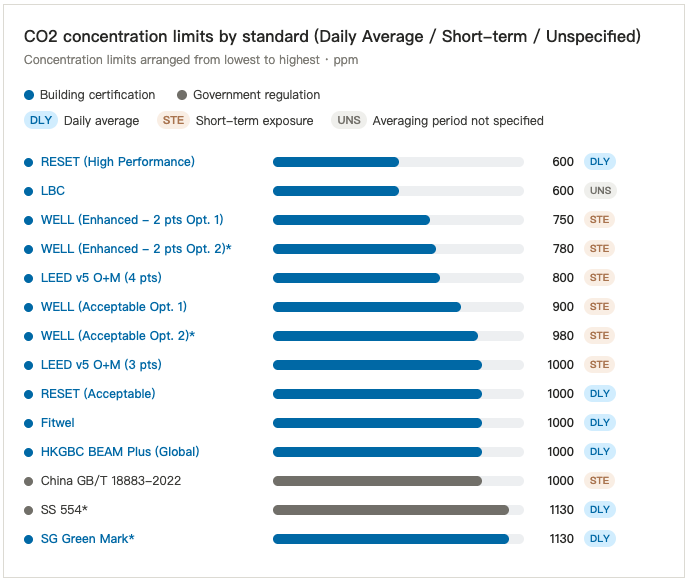
Note: SS 554, SG Green Mark, and WELL v2 Option 2 express CO₂ limits as a concentration above outdoor levels. An outdoor baseline of 430 ppm was used for this comparison.
Summary
Range: 600 to 1,130 ppm, a 1.9-fold gap, across 14 limits. This represents a relatively narrow spread compared to other pollutants in the dataset.
Strictest: RESET (High Performance) and LBC at 600 ppm, followed by WELL Enhanced Option 1 at 750 ppm and Option 2 at 780 ppm.
Most common value: 1,000 ppm, where five standards converge: LEED v5 O+M (3 pts, Short), RESET Acceptable (Daily), Fitwel (Daily), HKGBC BEAM Plus (Daily), and China GB/T 18883-2022 (Short).
Mid-range progression: Steps through WELL Enhanced (750–780 ppm), LEED v5 O+M 4 pts (800 ppm), and WELL Acceptable (900–980 ppm) before reaching the primary 1,000 ppm consensus.
Upper end: SS 554 and Singapore Green Mark at 1,130 ppm (Daily).
Type split: Building certifications dominate the stricter targets below 1,000 ppm, whereas government standards and building codes anchor the 1,000 to 1,130 ppm baseline range.
| Standard | Limit | Averaging | Type |
|---|---|---|---|
| RESET (High Performance) | 600 ppm | Daily | Certification |
| LBC | 600 ppm | Unspecified | Certification |
| WELL (Enhanced - 2 pts Opt. 1) | 750 ppm | Short-term | Certification |
| WELL (Enhanced - 2 pts Opt. 2)* | 780 ppm | Short-term | Certification |
| LEED v5 O+M (4 pts) | 800 ppm | Short-term | Certification |
| WELL (Acceptable Opt. 1) | 900 ppm | Short-term | Certification |
| WELL (Acceptable Opt. 2)* | 980 ppm | Short-term | Certification |
| LEED v5 O+M (3 pts) | 1000 ppm | Short-term | Certification |
| RESET (Acceptable) | 1000 ppm | Daily | Certification |
| Fitwel | 1000 ppm | Daily | Certification |
| HKGBC BEAM Plus (Global) | 1000 ppm | Daily (8 h) | Certification |
| China GB/T 18883-2022 | 1000 ppm | Short-term (1 h) | Government |
| SS 554* | 1130 ppm | Daily (8 h) | Government |
| SG Green Mark* | 1130 ppm | Daily (8 h) | Certification |
CO (Daily & Short-term & Unspecified)
Summary
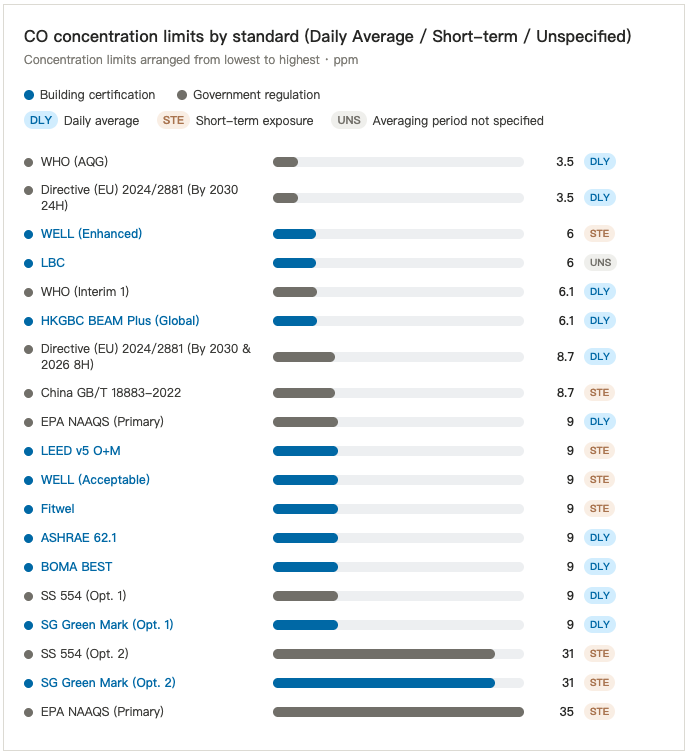
Range: 3.5 to 35 ppm, a 10-fold gap, across 19 limits.
Strictest: WHO AQG and EU Directive 2024/2881 (By 2030 24H) at 3.5 ppm (Daily).
Most common value: 9 ppm, where eight standards converge: EPA NAAQS Primary (24H), LEED v5 O+M (Short), WELL Acceptable (Short), Fitwel (Short), ASHRAE 62.1 (Daily), BOMA BEST (Daily), SS 554 Opt. 1 (Daily), and SG Green Mark Opt. 1 (Daily).
WHO alignment point: WHO AQG sets the strictest daily floor at 3.5 ppm, while WHO Interim 1 sits at 6.1 ppm alongside HKGBC BEAM Plus (Global).
Mid-range progression: Steps from WELL Enhanced and LBC at 6 ppm, through WHO Interim 1 and HKGBC BEAM Plus at 6.1 ppm, and EU Directive (8H) / China GB/T 18883-2022 at 8.7 ppm, leading into the major 9 ppm cluster.
Upper end: Short-term peak limits defined by SS 554 Opt. 2 and SG Green Mark Opt. 2 at 31 ppm, topped by EPA NAAQS Primary (1H) at 35 ppm.
Type split: Government standards define both the absolute strictest floor (3.5 ppm) and the upper short-term ceilings (31–35 ppm), while certifications heavily cluster around the 9 ppm consensus level.
| Standard | Limit | Averaging | Type |
|---|---|---|---|
| WHO (AQG) | 3.5 ppm | Daily | Government |
| Directive (EU) 2024/2881 (By 2030) | 3.5 ppm | Daily (24 h) | Government |
| WELL (Enhanced) | 6 ppm | Short-term | Certification |
| LBC | 6 ppm | Unspecified | Certification |
| WHO (Interim 1) | 6.1 ppm | Daily | Government |
| HKGBC BEAM Plus (Global) | 6.1 ppm | Daily (8 h) | Certification |
| Directive (EU) 2024/2881 (By 2030 & 2026) | 8.7 ppm | Daily (8 h) | Government |
| China GB/T 18883-2022 | 8.7 ppm | Short-term (1 h) | Government |
| EPA NAAQS (Primary) | 9 ppm | Daily (8 h) | Government |
| LEED v5 O+M | 9 ppm | Short-term (1 h) | Certification |
| WELL (Acceptable) | 9 ppm | Short-term | Certification |
| Fitwel | 9 ppm | Short-term (1 h) | Certification |
| ASHRAE 62.1 | 9 ppm | Daily (8 h) | Certification |
| BOMA BEST | 9 ppm | Daily (8 h) | Certification |
| SS 554 (Opt. 1) | 9 ppm | Daily (8 h) | Government |
| SG Green Mark (Opt. 1) | 9 ppm | Daily (8 h) | Certification |
| SS 554 (Opt. 2) | 31 ppm | Short-term (1 h) | Government |
| SG Green Mark (Opt. 2) | 31 ppm | Short-term (1 h) | Certification |
| EPA NAAQS (Primary) | 35 ppm | Short-term (1 h) | Government |
Conclusion: What Carbon Gas Targets Tell Us
Comparing how world standards handle carbon gases reveals two completely different regulatory philosophies operating under the same roof: one driven by acute human safety, and the other driven by cognitive performance and ventilation efficiency.
CO2 is about productivity, but lacks global consensus
Unlike particulate matter, where health agencies like the WHO set strict global benchmarks, carbon dioxide is treated as a proxy for ventilation rather than a direct toxin. Because of this, government standards rarely mandate strict indoor CO2 limits unless tied to ventilation codes. The push for tighter CO2 targets below 1,000 ppm is mainly driven by voluntary building certifications like RESET, WELL, and LEED, recognizing that CO2 levels can have an impact on basic health and occupants' ability to stay alert, focused, and productive.
CO targets reveal a rare international alignment
When it comes to carbon monoxide, the exact opposite happens. Because CO is an immediate, lethal poison, there is near-universal agreement on baseline safety. Almost every major certification and government standard converges around 9 mg/m³ for ambient daily or short-term exposure. Where standards diverge is not on baseline safety, but on high-exposure limits: stricter European and WHO targets cap allowable spikes far lower (3.5 mg/m³), recognizing that even lower continuous exposure can strain the cardiovascular system over time.
The broader takeaway
Carbon gases highlight the gap between building for minimum compliance versus building for human performance. A space that meets government baseline codes for CO2 and CO might keep occupants safe from acute danger, but pushing for lower CO2 targets is what transforms a safe building into a high-performing environment.
In Part 3, we apply this same lens to TVOC + Formaldehyde.
Appendix: Standards List and Resources for Carbon Gas
Government standards, codes, and guidelines (5 total):
World Health Organization (WHO). WHO Global Air Quality Guidelines: Executive Summary. p. 4.
US EPA NAAQS — National Ambient Air Quality Standards: NAAQS Table
EU Directive 2024/2881: EU Directive 2024/2881, Annex I
Singapore SS 554 (2021) : SS 554:2016+A1:2021 Code of Practice for Indoor Air Quality for Air-Conditioned Buildings. p. 20.
China GB/T 18883-2022: GB/T 18883-2022 室内空气质量标准. p. 3.
Building certifications and private frameworks (11 total):
RESET Air v2.0: RESET Air Standard.
LEED v5 O+M: LEED v5 Reference Guide for Building Operations and Maintenance. November 2025 Edition, pp. 67–68.
WELL v2: The WELL Building Standard v2.
Fitwel: Fitwel v3 Indoor Air Quality Assessment Protocol. p. 13.
Living Building Challenge (LBC): Living Building Challenge 4.1 Program Manual. January
ASHRAE 62.1 (2022): ANSI/ASHRAE Standard 62.1-2022: Ventilation for Acceptable Indoor Air Quality. 2022, p. 1.
DGNB: DGNB System – Buildings In Use, Criteria Set Version 2026. 2026, pp. 98–99.
BOMA BEST: BOMA BEST Field Guide.
Singapore Green Mark: SS 554:2016+A1:2021 Code of Practice for Indoor Air Quality for Air-Conditioned Buildings. p. 20.
HK BEAM PLUS: Existing Buildings Global Version. p. 157.
China Green Building Standard: 《绿色建筑评价标准》. 2024, p. 6.
